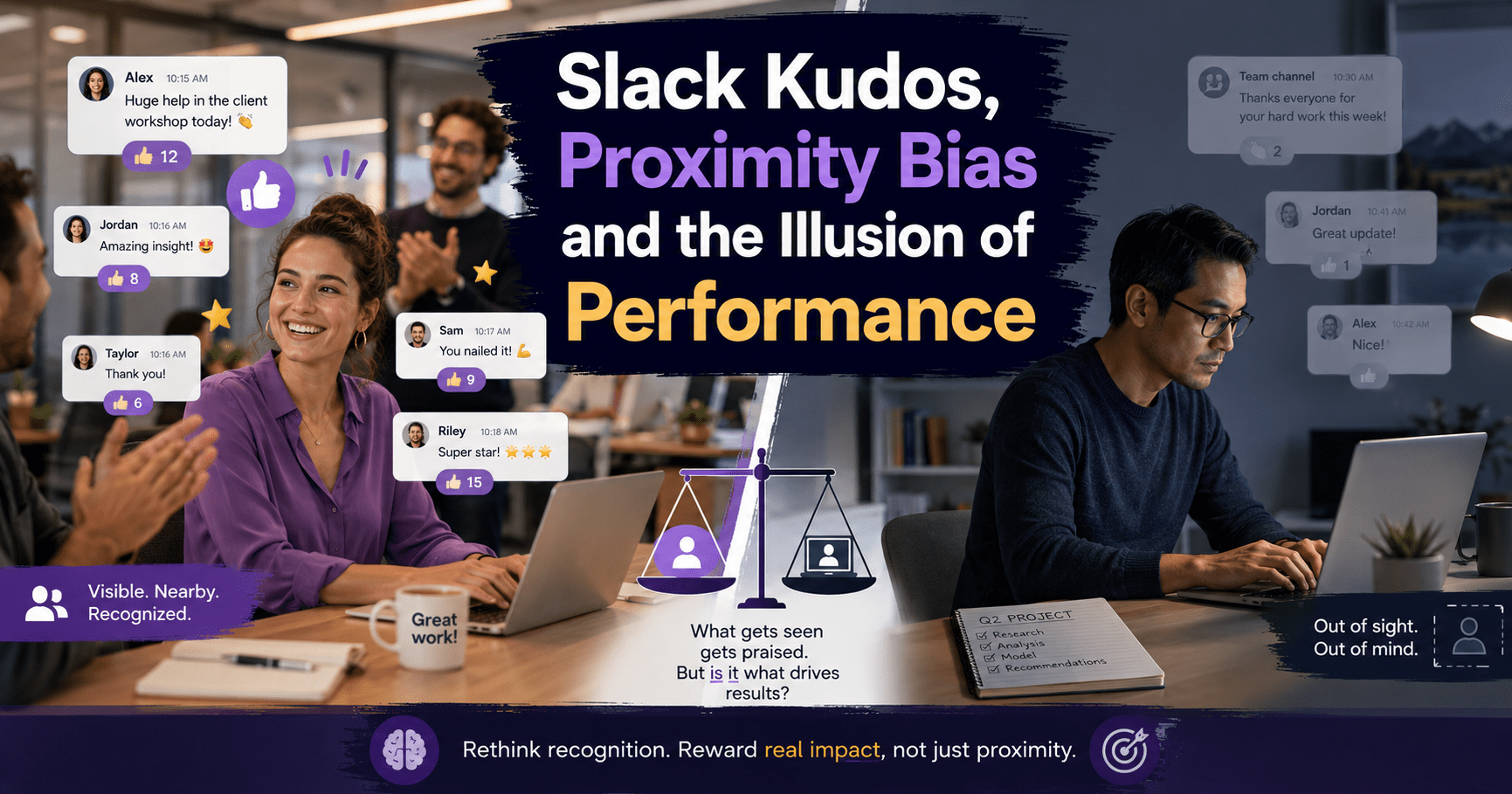
Slack Kudos, Proximity Bias and the Illusion of Performance
By Dan Moorhouse on 30/04/2026 in Project Management - Web Topics
Public praise at work sounds harmless.
A short message in Slack. A few emoji reactions. A quick dopamine hit for the person being recognised. In theory, everyone wins. Someone feels appreciated, the team sees positive behaviour being reinforced, and the company gets to say it has a culture of recognition.
But recognition is not always neutral.
In the wrong environment, a kudos app does not simply celebrate good work. It creates visibility. It shapes reputations. It tells everyone, publicly, whose contribution matters and whose contribution can pass without comment.
That is where workplace kudos starts to become uncomfortable.
The problem is not recognition itself. Recognition can be valuable when it is specific, fair and connected to meaningful outcomes. The problem begins when public praise becomes selective, vague, socially driven or politically convenient.
At that point, kudos stops being a morale boost and starts becoming a productivity killer.
The 11:30 Slack ping
Imagine two pieces of work happen on the same morning.
Bob from marketing is asked by an account manager to prepare an SEO report & recommendations ahead of a quarterly client meeting. Bob works in the office. So does the account manager. They know each other, speak regularly and have the benefit of casual face-to-face interaction.
At the same time, Matty from the development team is asked to investigate the state of a client’s ecommerce website following the clean-up of malicious activity. Matty reviews the damage, checks what has been restored, identifies what still needs attention, liaises with the client, helps restore missing functionality, and provides an in-depth security report with recommendations to reduce future risk.
Matty is a remote worker. He gets along with colleagues and does his job well, but he does not have the same personal relationships with office-based staff. He is not part of the passing conversations, the lunch chats, the quick desk-side updates or the informal social rhythm of the office.
An hour later, Slack pings:
Account Manager, 11:30am
Kudos to Bob for providing an SEO report for our client meeting. Completed in record time, with great pointers for improvement. Very much appreciated.
There is nothing wrong with thanking Bob. That is important.
Bob may have done exactly what was asked of him. The SEO report may have been useful. The account manager may have genuinely appreciated it.
The issue is not that Bob received praise.
The issue is what the organisation unintentionally signalled.
Because in that moment, one piece of work was made visible and celebrated. Another piece of work, arguably more urgent, technical and risk-heavy, went unnoticed.
Visibility is not the same as value
One of the biggest problems with public recognition tools is that they often reward visibility rather than value.
The work that gets praised is not always the most important work. It is often the work that is easiest to understand, easiest to describe, closest to the person giving praise, or most immediately useful to a visible meeting or deadline.
An SEO report is easy to recognise. It has a clear output. It supports a client meeting. It can be summarised in a sentence.
A technical security investigation is harder to recognise. It may involve invisible problem-solving, risk assessment, client reassurance, debugging, restoration work, documentation and recommendations. If done well, it may simply make a serious problem look calm and controlled.
That kind of work is often only noticed when it fails.
Security, infrastructure, maintenance, debugging, support and recovery work can be business-critical, yet strangely invisible. These tasks reduce risk, protect relationships and prevent future problems, but they rarely produce the kind of shiny, simple output that fits neatly into a kudos message.
This is where Slack recognition can become misleading.
It creates the appearance of an objective cultural signal, but in reality it may simply reflect who is seen, who is liked, who is nearby and whose work is easiest to explain.
The proximity bias problem
Hybrid and remote work have made this issue more obvious.
Office-based staff often benefit from proximity. They are physically present. They are easier to speak to. Their effort is more visible. Their personality is easier for managers and account teams to experience in small, everyday moments.
Remote workers do not always get that advantage.
They may be reliable, productive and technically excellent, but they have to work harder to make their contribution visible. They are not overheard helping someone. They are not seen staying calm under pressure. They do not benefit from the casual “thanks again for earlier” conversation by the coffee machine.
This does not mean office workers are undeserving.
It means the system is uneven.
When a kudos culture grows around informal visibility, remote workers can become structurally disadvantaged. They may contribute just as much, or more, but receive less public recognition because their work happens away from the social centre of the business.
Over time, that matters.
Public praise becomes part of someone’s reputation. It influences how others perceive them. It can affect who is trusted, who is invited into conversations, who is seen as dependable, and who is remembered when opportunities appear.
That makes kudos more powerful than it first appears.
When kudos becomes career currency
Companies often treat kudos as harmless positivity.
But employees do not always experience it that way.
When praise is public, repeated and visible to managers, it becomes a form of career currency. It creates a record of perceived contribution. It tells the organisation who is helpful, who delivers, who supports clients and who deserves appreciation.
That can be useful when recognition is fair.
It can be damaging when it is not.
If the same socially connected people are repeatedly praised for routine work while quieter employees are overlooked for complex or high-impact work, the kudos channel starts to feel less like recognition and more like internal PR.
Worse, it can create the conditions for undeserved progression.
Not necessarily through deliberate corruption. Not necessarily through managers consciously promoting their friends. Often it is subtler than that.
People remember what they see.
If Bob’s name appears regularly in public praise messages, Bob becomes associated with contribution. If Matty’s work happens quietly in the background, Matty may be seen as less active, less visible or less engaged, even when the opposite is true.
That is the danger.
Kudos can make average work look exceptional and exceptional work look invisible.
The emotional tax of being overlooked
There is also a productivity cost that is harder to measure.
When someone sees public praise handed out selectively, they may not immediately say anything. They may not complain. They may not even fully understand why it bothers them.
But they notice.
They notice when routine work gets celebrated and difficult work is ignored. They notice when office friendships seem to generate recognition. They notice when praise appears to follow social closeness rather than contribution.
That creates emotional drag.
The overlooked employee starts asking questions that have nothing to do with the work in front of them:
- Was my work not important?
- Does anyone understand what I actually do?
- Do I need to be more visible instead of more useful?
- Is progression based on contribution or relationships?
- Would this have been recognised if I worked in the office?
Those questions are distracting.
They pull attention away from the task. They create resentment. They reduce trust. They make people second-guess whether doing good work is enough.
This is how a simple kudos message can become a productivity killer.
Not because praise is bad, but because unfair praise creates noise in people’s heads.
It teaches people to optimise for recognition
A poor recognition culture does not just affect the people who are overlooked. It changes the behaviour of the wider team.
People are observant. They learn what gets rewarded.
If they see that visible, easy-to-package work receives public praise, they may start optimising for visibility rather than value.
That can lead to some unhealthy habits:
- – posting unnecessary updates to look busy
- – turning routine tasks into public achievements
- – copying managers into conversations for visibility
- – prioritising work that is easy to praise over work that is genuinely important
- – seeking quick wins instead of solving deeper problems
- – making collaboration performative rather than useful
The organisation may think it is building a positive culture.
In reality, it may be training people to advertise themselves.
That is not productivity. That is internal marketing.
The answer is not to ban kudos.
The answer is to make recognition better.
Good recognition versus bad recognition
Good recognition is specific. It explains what happened, why it mattered and who benefited. It gives context. It highlights outcomes. It recognises both visible and invisible work.
Bad recognition is vague. It rewards likeability, proximity or convenience. It celebrates routine work without context while missing more meaningful contributions elsewhere.
What companies should do instead
If companies want kudos tools to improve culture, they need to treat recognition as something that requires care.
They should start by setting expectations.
What deserves public recognition? Is it any completed task, or work that had a meaningful impact? Is the kudos channel for exceptional contribution, quiet support, client impact, problem-solving, collaboration, or all of the above?
Without shared standards, recognition becomes random.
Managers should also be encouraged to look for invisible work. Not every valuable contribution comes with a neat deliverable. Some work prevents problems. Some work reduces risk. Some work supports colleagues quietly. Some work protects client relationships in ways that are not immediately obvious.
Those contributions need to be recognised too.
Companies should also pay attention to patterns.
- – Who gets praised most often?
- – Who rarely gets mentioned?
- – Are remote workers recognised fairly?
- – Are technical, operational or support roles being overlooked?
- – Do the same people keep praising each other?
- – Are public kudos messages reflecting genuine impact, or simply social closeness?
These are uncomfortable questions, but they are necessary.
Because if a recognition system repeatedly favours the same groups of people, the company should not dismiss that as coincidence.
It should investigate the pattern.
Do not confuse kudos with performance
Perhaps the most important point is this: kudos should never replace proper performance assessment.
Public recognition can be useful evidence, but it is incomplete evidence. It is shaped by visibility, confidence, communication style, relationships, job role and proximity to decision-makers.
Managers need to look deeper.
They should assess outcomes, quality, complexity, reliability, client impact, teamwork, risk reduction and consistency over time.
A person who receives lots of public praise is not automatically a high performer.
A person who receives little public praise is not automatically less valuable.
Some of the most important employees in a business are the ones preventing chaos quietly in the background.
If leaders rely too heavily on visible praise, they will misunderstand their own organisation.
Recognition needs responsibility
The issue with Slack kudos is not that Bob received praise.
The issue is that many companies mistake public praise for fairness.
A kudos app can only reflect the culture around it. If a workplace already has proximity bias, favouritism, poor management visibility or a weak understanding of technical work, a kudos channel may amplify those problems rather than solve them.
Used well, recognition can strengthen a team.
Used lazily, it becomes noise.
Used politically, it becomes dangerous.
Companies need to stop treating public praise as harmless positivity and start treating it as a signal of what the business values.
Because employees are already reading it that way.
Every kudos message says something.
The question is whether companies are paying attention to what is being said.
Share this post


Dan Moorhouse is a web developer based in Thornton-Cleveleys, Lancashire.
He has a wealth of experience working across educational and agency settings, mainly working on PHP Content Management Systems such as Drupal, WordPress, including legacy backends and custom integrations.